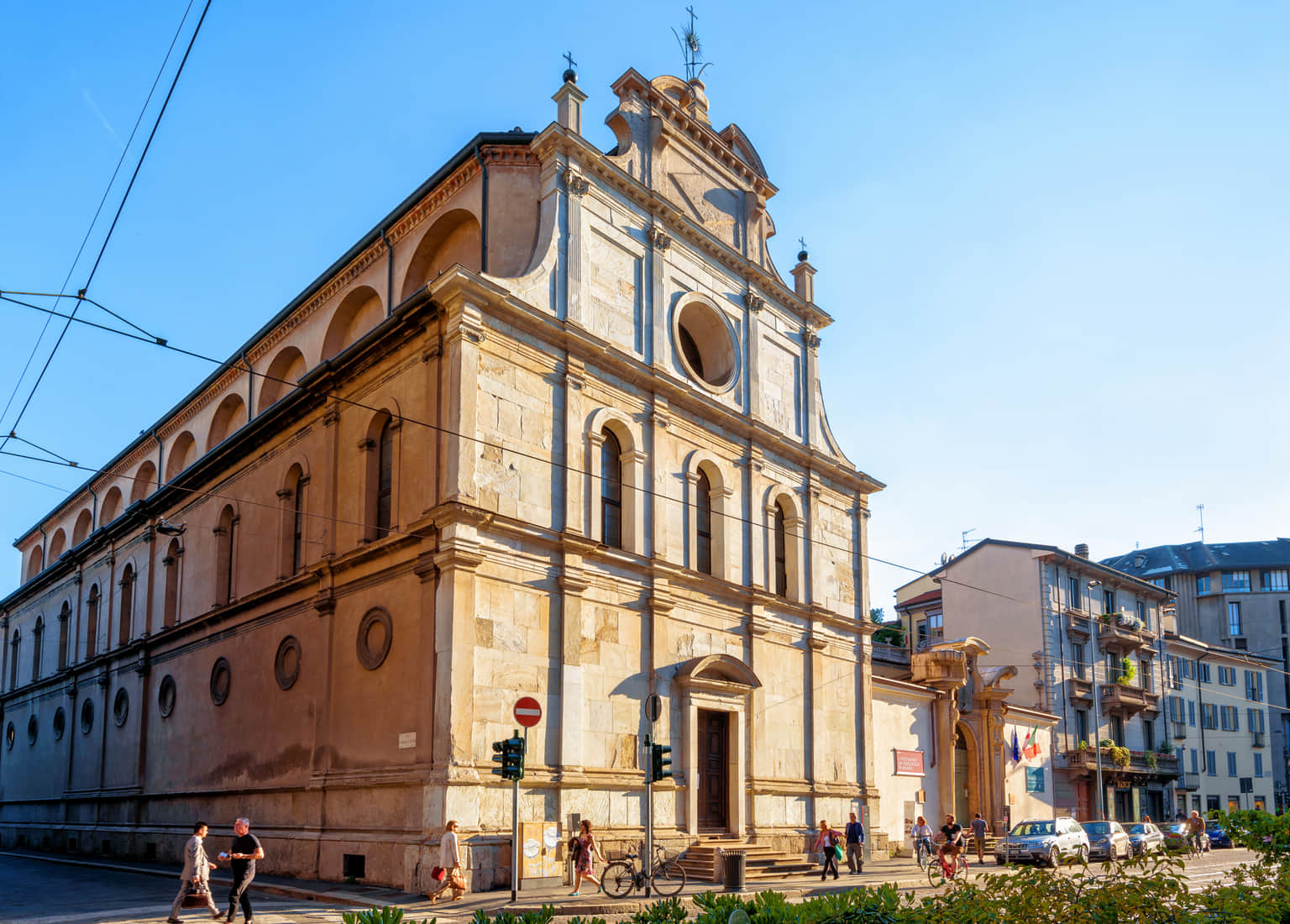
Location: Corso Magenta, 15, 20123 Milano MI, Italy
Timing: Tue-Sun 9.30 am-5.30 pm, closed on Monday
Entry fee: No entry cost
Distance from Nearest Airport: The nearest airport to this historic church is Milan Linate Airport which is approximately 9.2 Km away via Viale Enrico Forlanini. It takes about 15 minutes to cover the distance if traveling by car or taxi.
History of San Maurizio al Monastero Maggiore

The church is an outstanding ancient structure in Milan and is preserved to keep the heritage alive. It is believed that it was built on pre-existing Roman foundations and its construction started in 1503.
The design of the church was planned by famous Italian architect Gian Giacomo Dolcebuono, who also designed the cathedral of Milan. The complex (Church and Convent) served as the Prayer Room for the public or worshippers, while the convent was made exclusively for the nuns.
For almost three centuries the nuns were not allowed to cross the dividing wall and can attend the masses held in the church only hidden from the views.
It was earlier part of Monastero Maggiore, Milan's most prominent female convent of the Benedictines and got its name from there. Today, the complex is serving as a church and a museum and is open daily for both prayer offerers and art aficionados.
Public and Convent Halls at San Maurizio al Monastero Maggiore

The San Maurizio al Monastero Maggiore is complete with beautiful frescoes and is known for its spectacular paintings by Bernardino Luini. The entrance is through the church and the complex comprises two main parts:
Public Hall: This is a smaller hall and is open for the public and the congregation. Eight chapels, distributed on both sides, are mostly painted by the Luinis. It follows a simplistic rectangular floor plan and has ten bays. The roof is covered with the barrel-vaulted ceiling and is decorated with false ribs and other details
Convent Hall: This part is bigger and is strictly reserved for the nuns. This place is also called the Hall of the Nuns. This place is artistically decorated with the great work of Lunin and his sons. It also has in possession an extraordinary 16th-century organ, which still works despite being so ancient. This large hall has six bays and is used for the nuns for staying and performing choirs.
Frescoes at San Maurizio al Monastero Maggiore

The beautiful San Maurizio church is known worldwide for its stunning frescoes. These art pieces not only beautify the walls and chapels of the church but enhance the heritage value of the structure.
These art pieces date back to the 16th-century and present a marvelous display of the artistry of old times. The most famous frescoes are the works of Bernardino Luini, a student of the famous artist Leonardo da Vinci.
His frescoes include frescoes in the St. Catherine Chapel, on both sides of the partition wall, and the Chapel of St. Catherine of Alexandria, etc. The dividing wall's fresco depicts the Life of San Maurizio by Bernardino Luini and also has a masterpiece Adoration of the Magi
by artist Antonio Campi (1578).
The public area, the Bergamina chapel also has frescoes of Aurelio Luini, son of Bernardino, and his brothers. There is an array of frescoes and artworks of other artists as well in public areas. The counterfaçade comprises a fresco by Simone Peterzano (1573), while Simonetta chapel has the creativity of the Piazza family.
Tips for Visiting San Maurizio al Monastero Maggiore

1) The church gets crowded during peak seasons, so if you do not like visiting crowded places, plan your visit in the off season.
2) Milan being a fashion hub hosts several fashion exhibitions and events so book your hotels in advance to avoid discomfort.
3) Do not forget to keep an umbrella with you if traveling during winters as Milan experience a good amount of rainfall in winters as well.
4) There is a dress code to follow to enter the church as shoulders and bare skin needs to be covered.




_-_2022-09-03_-_1.jpg?w=1536&q=65&format=auto)
.jpg?w=1536&q=65&format=auto)