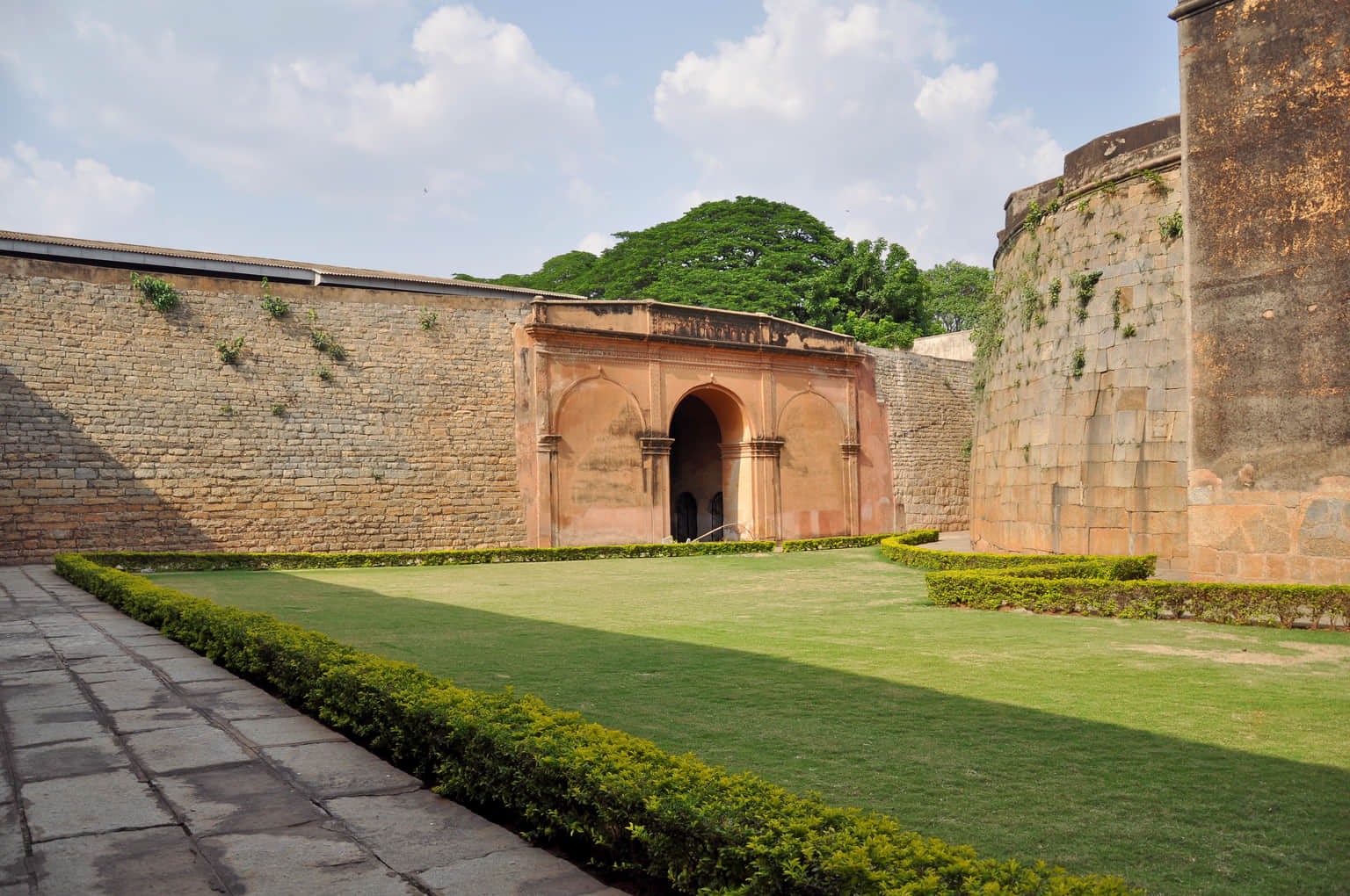
The silicon valley of India, Bangalore adorns the majestic Bangalore Fort, also known as Tipu Sultan’s fort that stands testament to the rich history of the Kingdom of Mysore and is a powerful edifice of Indian history. The fort takes you through the different architecture styles, their influences and evolution and has its own share of history engraved deeply in the fascinating stone structure.
It represents the architectural creativity and brilliance of the Mysore rulers and is one of the most popular monuments in India, that still does not fail to mesmerize the spectators.
The fort is a living testimony of the notorious struggle of the Mysore Empire against the mighty Britishers. A portrayal of bravery and dexterity, this palace is also known as the abode of happiness or the Rash-e-Zannat; meaning the Envy of Heavens and showcases the brilliance of Islamic architecture prevalent in India during that time.
Tipu Sultan’s summer palace now stands as a separate entity and is a prime attraction of the fort which was extensively used by the ruler as a summer retreat. This wonderful piece of architecture was entirely made up of teakwood framework and Islamic interiors.
The fort was open for the general public back in 2005. It's interesting to see that most of the fort is in ruins after witnessing many battles, but once inside it, you can see several artificial ponds, arsenals, rest areas and half a century old Ganpati shrine. The beautiful paintings and murals on the walls narrate the ruler’s bravery and chivalry and his hatred towards the British.
History of Bangalore Fort:

The beautifully constructed Bangalore Fort was initially built as a mud fort in the year 1537 by Kempe Gowda, the chief of the Vijayanagara Empire and the founder of the megacity Bangalore. Gowda had a dream to create a city which would be as beautiful as Hampi and would be a capital city with a fort, temples, tanks or water reservoirs and a cantonment.
So Gowda went on to create a charming city and fortified it with mud. In 1687, the Mughals took possession of the present-day Bangalore city and leased it to Chikka Devaraja Wodeyar, the then King of Mysore in 1689, who further expanded the existing fort.
Almost 100 years later, the fort was renovated and strengthened with stones by Hyder Ali, the father of great warrior Tipu Sultan, also known as the Tiger of Mysore.
The magnificent fort was spread across a mile and was flanked by wide ditches which were commanded by 26 towers encircling its ramparts and protecting the palace from all the sides. The construction of Tipu’s fort was initiated by his father Hyder Ali in 1781 and was completed by him in 1791.
In the year 1791, the fort was attacked by the fierce British East India Company led by Lord Cornwallis, after killing almost 2,000 people. Following the bloody battle, the British Army captured the palace and ruptured through the walls during the Third Mysore War near the Delhi Gate.
At the time the citadel in the siege of Bangalore became a stronghold for Tipu Sultan. A part of it was destroyed largely due to the battle but was later restored under his aegis.
The architecture of Bangalore Fort:
The imposing monument has an unusual oval shape and is protected by thick walls, with visible marks of the damage caused by Lord Cornwallis and his army in the attempt to breach and capture the fort. One of the distinct features of the fort is a tall gate with three massive iron knobs that suggest guarded quarters and is reminiscent of the ancient Karnataka architecture with carvings of lotus, peacocks, elephants, birds and other elaborate motifs.
The fort is spread across 2 floors with teak wood interiors and stone and comprises 4 royal rooms placed at four corners on the first floor, a large hall, chambers and two balconies from where the sultan used to address the officials and held his raj durbar. Inside the fort complex stands a beautiful Ganapati mandir which was constructed in the 16th century and is currently deserted.
The two-storied palace of Tipu Sultan stands on a strong stone plinth and features exquisitely carved wooden pillars that rest over the stone base. There are teak wood pillars that act as a support for wooden beams covering the entire circumference of the palace. The walls and ceilings are handsomely painted in vivid colours and intricately carved in beautiful floral patterns and designs that portray Indo-Islamic architecture.
Legend of the Bangalore fort:

History is incomplete without some superstition. According to a famous legend, during the construction of the palace, the Southern entrance gate would collapse no sooner than it was built. The royal priests suggested a human sacrifice as a solution to ward off the evil spirits.
Kempe Gowda, the brain behind the fort, was totally against it. It was when one night his daughter in law, Lakshamma beheaded herself with a sword near the Southern gate, that the fort was completed without any further mishap.
After the construction of the fort was finally complete, Kempe Gowda got a temple built in the memory of his daughter-in-law in Koramangala. Such superstitions were always prevailing back then also, though Kempe Gowda was a rational ruler, who would never have agreed to this or allow anybody to do such a grave act.
Nevertheless, his daughter-in-law is said to have escaped at night and sacrificed herself listening secretly to her father-in-law’s problems.